
“Lo Puro” in Tango
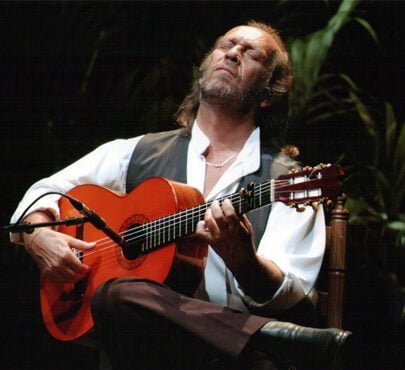
Watch Paco De Lucía play.
His mind is a few feet to the right of his head. Not absent — more present than presence. Displaced outward, into the guitar, into the room, into something that exists in the space between him and the music rather than inside his skull. The eyes are soft, the body still, the attention total. You are watching a man in search of something — and you are watching him find it, right now, in this moment.
He called it *lo puro*. And he was precise about what it meant: *lo puro* is not *lo antiguo*. The pure is not the old. It is what comes from and grows in the heart. The tradition was never the forms it left behind — the specific chord, the particular rhythm, the approved sequence of movement. It was the quality of searching that produced those forms. The aliveness. The openness to new sounds. The willingness to follow what was real, without flinching, to the end — and then to keep following, because the search does not end.
This is what we inherit. Not the archive, but the *búsqueda.*
—
Astor Piazzolla went to Paris carrying his classical compositions — the work he thought was serious, legitimate, the thing he had won prizes for being. Nadia Boulanger looked through all of it and was unmoved. Then she asked who he actually was. He played her tango, probably with some embarrassment. She pointed at it and said: *there. That is you. Don’t ever abandon this.*
He had been carrying the real thing around like a secret he was ashamed of — while presenting the imitation as his legitimate self. The values were exactly inverted. Ashamed of the gold, proud of the brass.
Piazzolla spent the rest of his life amplifying what was already real in tango — the longing, the violence, the sophistication, the Buenos Aires streetness of it — following it further than anyone had dared, trusting what he felt over what the traditionalists said it had to be. He integrated classical forms, cross-rhythms, jazz harmonies. He was not betraying the tradition. He was refusing to let its search stop. He understood that tango had always been moving, always leaning forward into something it had not yet become — and that to freeze it at a moment, however golden, is to kill it.
*Lo puro* is not invention. It is amplification. The implicit thing, followed all the way — and further.
—
Now arrive at tango.
The golden age was golden not because of its decade but because of its searching. The music was alive because the players were still finding something. The dance was alive because its many dancers were genuinely moving into the unknown together.
What we inherit is not the forms but the standard of aliveness — and aliveness is always in motion. To mistake the form for the life is to stuff the bird and call it ornithology.
—
The embrace is a conversation. But more than that — it is a joint searching.
*Are you there? Yes. Are you still there? Yes, here I am!*
*Can we see this? Yes, and look where it goes…*
This can scarcely be choreographed or recalled from memory. It lives in the movement between two people who are genuinely searching — not for steps, not for approval, but for what this music, this moment, this particular other person makes possible. The embrace takes the ordinary fact of another person, their weight, their breath, their intention, and turns up the resolution on it. Makes it *more itself*. Like sharing the joy of learning to walk.
In daily life we mostly let such things be background, half-attending. The embrace says: not now. You are not background. I am going to move into this with you — not knowing where it goes — and whatever unfolds there we discover together. Or, perhaps more exactly, we bring into being. It was not waiting for us: it becomes possible because we searched.
That is what music does to time. Time already passes: music makes it *move toward something*. The dance does the same to the person in front of you. The searching has always been the art.
—
The philosopher Iain McGilchrist describes two fundamental modes of attention. The brain’s left hemisphere categorises, abstracts, preserves — it knows *about* things, reduces them to manipulable form, builds archives. In contrast the right hemisphere reaches outward toward what is living and other — it knows things *through* encounter, through presence, through the unrepeatable now. Both are necessary. But they are not equal in what they can hold.
The left hemisphere alone cannot hold a *búsqueda*. It can hold the results of one — the steps, the codes, the recordings, the conventions of the milonga — and it will preserve these with great fidelity and defend them with great conviction. But the search itself, the living forward movement of an art through time, belongs to the right hemisphere: open, world-directed, genuinely not knowing what comes next.
This is why tradition calcifies. Not through malice. Through the wrong instrument. The archive mistakes itself for the thing, because the thing — the actual ongoing search — has moved on and left no forwarding address.
What you cannot archive is the willingness to remain within it. That must be chosen, again, by every dancer, in every embrace, in every generation.
—
The enemy of *lo puro* is not novelty. It is the stopped search.
“If you lack technique you lose the freedom to create”, said De Lucía. Two bodies, one embrace, one music, the floor, technique — these are not arbitrary constraints but the very conditions that make the search possible in tango. Without them there is nothing to search within. The mistake is to confuse the container with its current contents — to defend not the embrace but this particular posture, not the music but these particular orchestras, not the tradition but the moment some left hemisphere decided that tradition was complete.
You can dance to D’Arienzo and be genuinely searching — listening, following, finding something you didn’t know was there. You can dance to music nobody has heard and be utterly closed — executing, performing, narrating your own competence to yourself. The decade is irrelevant. The question is whether the search is alive.
Do not blame institutions or codes for doing their thing: they are necessary materials. But do not let them tell you the search is over. And do not come back from Paris carrying your classical compositions while the real music waits in your hands, unacknowledged.
—
Progress in tango is not a new vocabulary of steps. It is a deeper willingness to search — in the body, in the couple, in the tradition. A greater capacity to move into not-knowing. An embrace that is more genuinely an offer — not *I will show you what I know* but *let’s find out what we don’t*. This has no ceiling.
—
In tango this movement is different, because the body cannot be left behind. It is not the vehicle but the instrument. Attention doesn’t leave the body, it emanates from it. The body stops being something you manage and becomes something you listen through, search through, reach the other person through. The boundary between you and the music, between you and your partner, becomes unclear — not because you have lost yourself, but because you are fully arriving.
This is what precision means in tango. Not the correct angle of the arm. Not the approved posture. Those things matter, like an instrument must be tuned, but they are not the ends. A presentient response to a change of weight, the stretching of a beat rather than the demarcation of it, what is actually happening rather than what you expect. You learn the technique so that the body becomes sensitive enough to detect at that resolution. And then you stop managing the body, you let it attend.
The search goes deeper, not necessarily into what was latent, but into what the searching itself makes possible. That may be stillness, or it may be fire — a barely perceptible shift in weight, or an explosion of dynamics that neither of you planned. Both possible, neither decided in advance. What makes it *lo puro* is not the size of the response but its honesty — that it came from perception rather than display, from searching rather than programme, from spirit rather than prescription.
That is perhaps what they were doing in Buenos Aires in 1943. That is what Piazzolla finally allowed himself when someone refused to let him mistake the brass for the gold. That is what De Lucía was doing every time he played — not reproducing flamenco, but continuing its search, carrying it one step further into what it could be.
That is *lo puro*. Not what is old. Not what is new. What is inherited and still moving — and the precision and courage to move within it.
—
References
* Paco De Lucía on “lo puro”: see e.g. https://youtu.be/NY6cIRrTWrw?t=337. Or perhaps his album Almoraima (1976).
* Piazzolla on Nadia Boulanger: https://www.youtube.com/watch?v=bRwLQSGu0dE. Her effect perhaps audible in “Piazzolla, Vivaldi – Les quatre saisons” (David Grimal and Les Dissonances, 2010).
* Iain McGilchrist: The Master and His Emissary (2009); also many interviews online.